Web push is one of the cheapest ways to reach your audience. A small site can send notifications for free, and an online store with tens of thousands of subscribers spends less on push in a month than on a single SMS blast. Here is where the price comes from and how to avoid overpaying.
Browsers deliver push notifications at no charge. Google, Mozilla and Apple don't bill anyone for passing a message to a device. Unlike SMS, there is no carrier sending an invoice for every message.
What you pay for is everything around delivery: collecting and storing subscribers, servers that send millions of messages in seconds, segmentation, triggered flows, analytics and support. That is what push notification services sell.
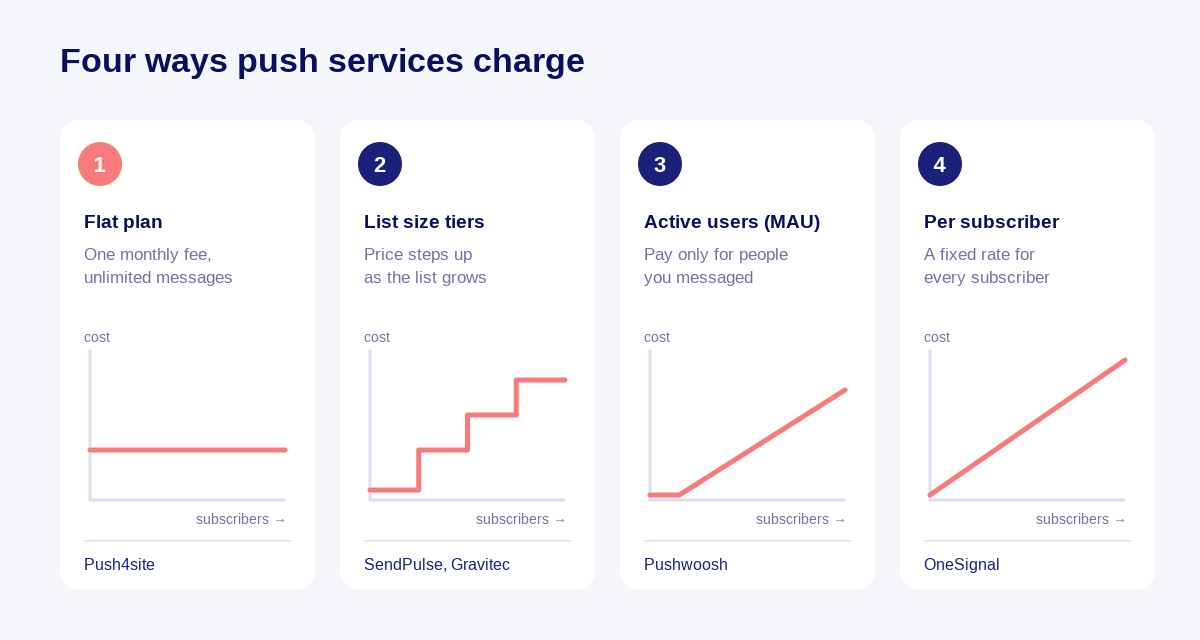
| Service | Free | Paid | Model |
|---|---|---|---|
| Push4site | 30-day trial | from $25/mo (business), from $50/mo (e-commerce), Enterprise on request | flat, unlimited messages |
| SendPulse | up to 10,000 subscribers | Pro: $24/mo for 30,000, $59/mo for 100,000 (40% off yearly) | list size |
| Gravitec | up to 10,000 subscribers, no Safari, branding | Fix: from $20/mo | list size |
| Pushwoosh | up to 1,000 MAU | $7 per 1,000 MAU (push only) | active users |
| OneSignal | yes, capped per send | Growth: $0.004 per web push subscriber per month | per subscriber |
Prices from each vendor's pricing page, November 2026. For features, not just prices, see our web push services comparison.
An online store has 40,000 subscribers. It sends three campaigns a week plus abandoned cart reminders, roughly 500,000 messages a month.
The gap is orders of magnitude. That is why push usually pays for itself with the first abandoned cart campaign.
Start with a trial, collect your first few thousand subscribers and watch the clicks. If you pay by list size, prune inactive subscribers regularly. And compare yearly billing: discounts reach 40%. To get the most out of every send, follow our step-by-step push campaign guide.
See Push4site pricing and start your 30-day free trial.
No. Receiving a push is free, and each message uses only a few kilobytes of data.
Yes, on free plans or from your own server. But your own server means development and maintenance, which also cost money.
Push and email cost about the same; SMS costs hundreds of times more. Push also skips spam filters and doesn't need the subscriber's address.
On the type of site and the features you need. The number of messages does not affect the price.

Thanks for contacting us!
We will contact you shortly!
Thank you for registering!
An email with a password was sent to the specified email


